
For decades, space stations have largely been associated with government-led programs such as the International Space Station (ISS). That picture is beginning to change as private companies develop their own platforms for research, manufacturing, astronaut missions, and other commercial activities in low-Earth orbit.
One of the most ambitious projects is Haven-1, being developed by Vast. The company describes Haven-1 as the world’s first commercial space station. As of 2026, the project has moved through several important development and testing milestones and is now targeted for launch in the first quarter of 2027.


5
What Is Haven-1?
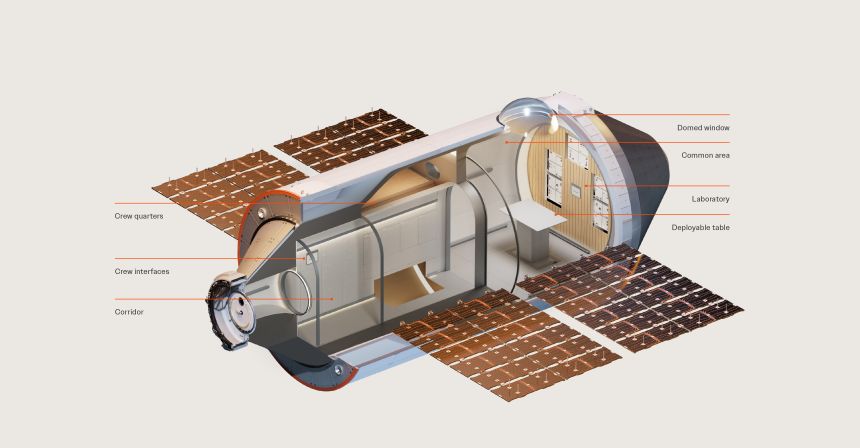
Haven-1 is being designed as a privately operated, crewed space station in low-Earth orbit. Rather than being a massive station assembled from many modules from the beginning, the project starts with a single standalone module.
Vast says Haven-1 is designed to accommodate four crew members and provide approximately 45 cubic meters of habitable volume. The station is planned to orbit at an altitude of about 425 kilometers with an inclination of 51.6 degrees.
The station is intended to support private astronauts as well as government missions. It will also contain a laboratory environment where researchers can conduct experiments in microgravity.
This makes Haven-1 more than simply a destination for visitors. Its long-term objective is to provide useful infrastructure for scientific research, technology development, and commercial activity in space.
A New Era of Commercial Space Infrastructure
The idea behind commercial space stations is closely connected to the growing private space industry. Companies are increasingly looking beyond launching satellites and spacecraft and are exploring ways to operate infrastructure in orbit.
A privately developed station could eventually provide opportunities for:
- Microgravity research
- Scientific experiments
- Technology demonstrations
- In-space manufacturing
- Private astronaut missions
- Government research
- International collaboration
The commercial model could allow organizations that do not operate their own space station to purchase access to laboratory facilities and crew time.


5
Designed With Humans in Mind
One of the notable aspects of Haven-1 is its emphasis on the human experience.
Living in orbit is very different from living on Earth. Astronauts work in microgravity, have limited personal space, and need to operate complex equipment while maintaining strict safety procedures.
Vast has therefore placed considerable attention on the station’s interior design. The company has worked with experienced space professionals and designers to create an environment intended to combine practical functionality with comfort.
The station is planned to include personal crew quarters, a communal area, and a 1.1-meter domed observation window. These features are intended to make the spacecraft more useful and more comfortable for people spending time in orbit.
The interior concept includes carefully organized storage and work areas, helping crew members move around efficiently despite the absence of normal gravity.
A Laboratory in Orbit
Scientific research is expected to be one of Haven-1’s major purposes.
Microgravity can change how materials, fluids, biological systems, and manufacturing processes behave. Researchers can therefore use orbital laboratories to investigate phenomena that are difficult or impossible to reproduce under normal Earth gravity.
Vast describes Haven-1 as having an innovation laboratory designed for microgravity research, development, and manufacturing opportunities.
Potential users could include universities, technology companies, research organizations, and government agencies.
For commercial space development, this is particularly important. A space station does not have to generate value simply by carrying people. The experiments and products developed aboard it could eventually have applications on Earth.
Haven Demo: Testing the Technology Before Haven-1
Before moving directly to a crewed station, Vast used a smaller spacecraft called Haven Demo to test important technologies.
Haven Demo launched on November 2, 2025, as part of the Bandwagon-4 rideshare mission. During its orbital mission, the spacecraft tested systems including power, communications, navigation, propulsion, thermal control, avionics, and flight software.
The demonstration mission was designed to provide real-world flight experience before the company committed to the more complicated Haven-1 mission.
Vast reported that Haven Demo completed 49 test objectives during its roughly three-month mission. The spacecraft was subsequently deorbited in a controlled operation in February 2026.
That step is important because hardware can behave differently in orbit than it does during laboratory testing. Real flight data can reveal issues and provide information that engineers can use to improve future spacecraft.


Haven-1 Enters a New Stage
In January 2026, Vast announced that Haven-1 had entered its integration phase.
The integration process involves bringing together the different systems needed to transform the station’s primary structure into a complete flight-ready spacecraft. These include life-support equipment, thermal-control systems, propulsion components, avionics, guidance systems, air-revitalization hardware, shielding, radiators, solar arrays, and crew-habitation equipment.
Vast has also reported completing pressure and structural testing of the station’s primary structure. Such tests are essential because a crewed spacecraft must withstand the stresses of launch and maintain a safe pressurized environment once it reaches orbit.
According to the company’s current schedule, Haven-1 is targeted to be ready for launch in Q1 2027.
SpaceX Will Provide the Launch and Crew Transportation
Haven-1 is contracted to launch aboard a SpaceX Falcon 9 rocket from Florida. Vast also plans to use a SpaceX Dragon spacecraft to transport crew members to the station.
The relationship is significant because successful commercial space stations require more than the station itself. They also need reliable transportation for crew, communications, launch services, and eventually cargo.
Vast says Haven-1 will use Starlink connectivity, providing high-speed communications between the station and the ground.


6
What Could Haven-1 Mean for the Future?
Haven-1 is being developed as the first step in a much larger vision.
Vast plans to follow Haven-1 with Haven-2, a modular station intended to expand the company’s capabilities and eventually support continuous human presence in low-Earth orbit. The company says it plans to begin launching Haven-2 modules in 2028, with the goal of creating a four-module station capable of continuous crew operations by the end of 2030.
If those plans succeed, the significance of Haven-1 could extend well beyond its first launch. It could serve as an early example of how privately operated orbital infrastructure might develop after the ISS era.
Challenges Still Remain
Despite the progress, launching and operating a crewed space station remains an extremely difficult engineering challenge.
The station must maintain life support, power, communications, thermal control, navigation, propulsion, radiation protection, and orbital safety. Every major system must work reliably because astronauts will depend on it.
There is also the challenge of making commercial space activity economically sustainable. Research customers, private astronauts, government agencies, and manufacturing companies would all need to generate enough demand to support the cost of operating the infrastructure.
For these reasons, Haven-1’s successful launch and operation will be more than a technological milestone. It will also be an important test of whether private companies can build sustainable businesses around human activity in orbit.
Final Thoughts
The movement toward privately operated space stations represents a major change in the way humanity approaches low-Earth orbit.
Haven-1 is currently targeted for launch in the first quarter of 2027, and Vast has already completed significant testing and development work leading toward that mission.
If the mission succeeds, Haven-1 could become an important milestone in commercial spaceflight, providing a dedicated platform for astronauts, researchers, technology developers, and future in-space industries.
The project also points toward a broader future in which low-Earth orbit may become a more active commercial environment—not just a place visited by government astronauts, but an increasingly accessible destination for research, manufacturing, and private missions.